

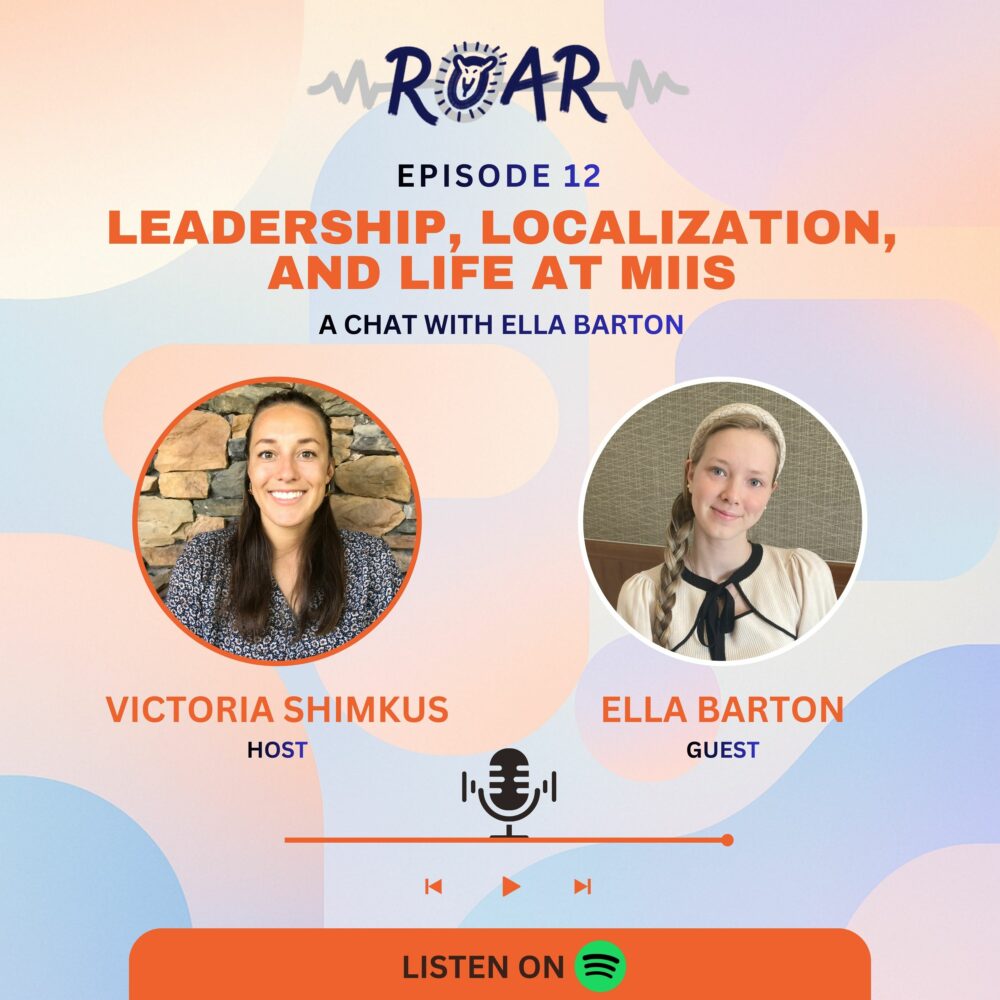
In this episode, we sit down with Ella Barton, a second-year MIIS student and the Chapter Manager of Women in Localization at MIIS. From studying at UT Austin to stepping into the world of translation and localization, Ella has followed opportunities with openness and courage.
She shares the soft skills she believes truly shape effective leadership: empathy, communication, and the ability to build a supportive community. She opens up about the challenges of balancing studies with leading a student chapter, and how those responsibilities have strengthened her commitment to the localization field.
Whether you’re curious about building a career in localization, developing leadership skills, or simply want to hear her story , this episode is for you.
Transcript
Victoria:
Welcome to another episode of the ROAR podcast, a podcast produced by the Middlebury Institute’s Translation and Localization Management Program, where we’re bringing together global voices from the localization industry. I’m your host for the episode, Victoria Shimkus, and today I’ll be talking with Ella Barton, the Chapter Manager of Women in Localization here at MIIS.
Victoria:
Hi, Ella. How are you? Thanks for joining me for the podcast today.
Ella:
I’m doing well. Thank you. Thanks so much for having me. I’m very excited to chat. I’m excited as well.
Victoria:
So, let’s get started. I would love for you to just tell us about you. Who are you? Who’s Ella Barton?
Ella:
That’s a good question. Let me think. Well, I think as a lot of MIIS students know, I moved from Texas in January. So I spent basically all of my young life and education in Texas, but my family’s from Canada. Everyone loves to make fun of my funky accent.
Victoria:
I’m just kidding.
Ella:
Yes. Don’t need to tell some of my classmates, they tease me enough already, but yeah. So I’m a dual citizen Canadian-American and I went to UT Austin. I say this because I met my husband just in there and we both were studying Japanese at the time. I did an Asian Studies degree, and I had no idea what I was going to do with my degree.
Well, I had an idea. I was going to do translation. I knew I wanted to go into translation. So I did go into translation eventually, and then I found localization and project management through that and ended up really enjoying that. So, I would say I started kind of with an idea, but I feel like with localization, everyone comes into it in a funky way.
No one comes in and is like, I’m going to do a localization. This is what I’m going to do. It’s like, oh yeah, I was a random whatever, whatever. And then I found this because I was like bilingual or I ended up doing project management within localization because I was a linguist or stuff like that. I wanted to be a ballet dancer when I was little and then I got two massive knee injuries. So that led me into down the languages path anyway.
Victoria:
Okay. Yeah. And so even picking a college major is kind of hard. Like it took me till after my first two years to pick a major. So, did you know going into university that you wanted to study Japanese or how did that come about?
I did actually. So I, I started studying Japanese when I was, realistically when I was 12 because there was a class offered at my middle school, which is super rare in Texas. So I, I started that and I, I really, really enjoyed it and I knew I wanted to do that at that point, continuing into the future. And so I knew I wanted to do that major specifically because I continued to take classes at my, what’s the word community college.
And then I, it was the idea where I did my core there and then went to UT Austin for only, it was like a year and a half, two years. So I had to, I had to pick very quickly for that reason, partly. And so I was like, yeah, I know I want to do Japanese. It was the only school in Texas that even had Japanese as a major. So I went very specifically to UT Austin for it.
Victoria:
Nice. And what draws you to the Japanese language?
Ella:
Oh, I don’t, this question every time gets me because everyone always asks this question. And I think for some people it’ll be like pop culture related, it’ll be comic books or gaming. I do like Japanese games.
I don’t play games myself, which is kind of silly, but like I enjoy the narrative design and the music and things like that. I’m not really an animation kind of person. So what drew it to me originally was not such a specific thing. It was offered at my school and I found that I really, really liked it. And I think because the people who were teaching me Japanese at the time were really strong, like core pillars in my life.
Like my teachers were not as strong as to say like parents for me, but extremely, extremely supportive people that shaped my development as a child and a young adult. So it became something that was so comfortable to me, I think. And so I just felt like it almost like you’re in too deep, you know, and you’re like, this is kind of not a part of me per se, like the language isn’t a part of me, but the experience of continuing to learn the language and whatnot and explore it became something that I just couldn’t really detach from, I guess.
Victoria:
Okay. Who are those teachers? You want to give them a shout out?
Ella:
Oh my gosh. Listen. You could share this podcast with them. I’m just saying she’s my first Japanese teacher in middle school.
She was so harsh at first, like she made everyone cry. And she’d say like, she’s like watching me write on my like five sentences and in a timed like quiz or whatever, she’s like, this is not good. Like, I expect more from you. This is so bad. But then at the same time, at the same time, she was like really sweet.
Like she, cause I think she saw the potential in everyone. So I appreciated that. So she was great. All my community college professors were great. And one, one teacher, you know, you saw a sensei at UT Austin was fabulous.
And Justin and I, my husband and I were in her class together. So she came to our wedding. Oh, that’s sweet. Yeah. So I have a very soft spot in my heart for her.
Victoria:
Okay. So your husband speaks Japanese as well?
Ella:
Well, no, I don’t know that I knew that. So we were in the same class and he was so, he was doing linguistics at the time. He’s very talented.
He can really pick up on accent and cadence of a language very well. So I thought he was very gifted in Japanese. He’s, he’s Taiwanese American. So he speaks English and Mandarin, but was also, I felt like quite good at Japanese. But as soon as we started dating, he dropped Japanese actually.
Victoria:
Oh, why?
Ella:
I’m going to go into it.
Victoria:
Were you better at it? I’m just kidding.
Ella:
Was I what?
Victoria:
I said, were you better at it? Is that why he dropped it?
Ella:
I don’t think so.
Victoria:
I’m just kidding.
Ella:
Well, now, obviously, but no, he was like, I want to, he was like, you know, as a linguist, I’m not going to make any money and I want to make money.
And I was like, that’s great. You can make money for me so I can go and be a linguist and like, have a good time doing it. So yeah, he dropped it. But still, like sometimes we’ll meet up with people and he can kind of catch, you know, things from there. Yeah.
Victoria:
Well, now you’re studying the business side of language. So that’s kind of cool. Right?
Ella:
Yeah, it is cool. And now I’m studying business side. I can see why they don’t make money. I guess I see his point, I suppose.
Victoria:
Well, nice. Thanks for sharing. Sorry, I didn’t mean to pry into your personal life too much.
So I know that you came in as an accelerated student and you were studying Japanese in undergrad. So what was going on in the in between? Were you working? Did you go straight from undergrad to grad school?
Ella:
Yeah, good question. So I graduated in 2022. And then I think I worked for about two years before I came to MIIS. I was doing I did for most of that time I was doing freelance Japanese to English translation. And then the last like five months or so a very short time I was at We Localize doing Japanese QA, which was interesting because typically I only go into English. And that role was more into J content material.
So I didn’t I enjoyed it. But also I could really see where my limitations were, particularly like linguistically. And then also, I just didn’t know much about localization. And I was having trouble kind of, I wanted to pivot out of that position, but I just didn’t have enough experience. So I decided to come to MIIS so I could learn, like the multifaceted aspect, I guess that I wanted to take translation, interpretation, some coding classes, AI related management class, business translation, program management, like I just wanted to do…
Victoria:
Understand the whole picture, bigger picture.
Ella:
Yeah, I’m a general person. I wouldn’t say I’m super detailed, but specifics of doing that QA work at We Localize was a bit challenging for me because I realized I’m more like a generalist kind of I want to have a little piece of everything. The saying like, jack of all trades, but master of none. That’s how I feel. Yeah.
Okay, you get it. Yeah. Yeah. That’s how I felt.
Victoria:
Okay, nice. Um, what were your daily tasks as a quality assurance team member?
Ella:
I can’t say the most I feel like interesting things because of the NDA, but I was doing I think I can say I was doing entertainment. So our client was asking us to look at entertainment data and a lot of it was like video related. So I would check I was a metadata localization specialist, which is like a really like whatever that means kind of title, but I would check if it was something related to video content, I would check the metadata for the title and the description and like maybe episodes and things like that descriptions for each episode, and check to make sure that it all looked right for the JP market. And for JP in particular, they had two of us.
And typically, there would be only one person per locale or language, but it was very specific because of all that the anime related material, it was hyper focused, and then they’d have it where the JP market would have it organized in their database completely differently from for example, the Western markets and by Western, I mean, we included like every locale that would be considered in the West. So it would be Western Europe and the Americas, basically. So yeah, I was doing a lot of stuff just specifically for the JP market.
Victoria:
That’s cool.
Ella:
Yeah, it was fun, actually.
And we I mean, we could, we had a kind of interesting schedule, it was a follow the sun global model, because I mean, we look as huge. So we had offices in APAC and EMEA, and ours was the Americas, of course. So getting to have calls with like the Tokyo office and whatnot was fun and made it not feel as isolated. Yeah.
Victoria:
Would you speak Japanese with them on your calls?
Ella:
Yeah. Yeah, we would. I would. No, yeah, we did. So English for anything that the VPMs like my bosses needed, and then it was Japanese for the rest of it.
Victoria:
Okay, cool. And this question came from someone on our staff, we wanted to know if there were any notable differences in the localization philosophy between native English and native Japanese, like practitioners, were you working with any native Japanese? I mean, yeah, within your office, or even on those calls? And do you think that there was any kind of difference in the localization philosophy between the two cultures?
Ella:
That’s a good question. Because yeah, so I was, I was, again, kind of like, I wouldn’t be the ideal person to hire for that role, because I’m not a native JP speaker. So for sure, most of the people I was working with on the Japanese team were actually based in Japan and spoke Japanese as their native language. I do feel like there’s some sort of a difference, I guess. I don’t know, maybe philosophy wise, I’m not quite sure. But in everyday, like work application, I feel like localization studies in Japan is very centered around just like Japanese, English, English, Japanese translation, it’s not as broad as for example, admins, when we think about, okay, how would this look in Arabic?
You know, how do we tackle RTL languages? How do we tackle by die support? Or okay, we’re gonna do this assignment this week, and you’ve got to do one CCJK language, and you’ve got to do one fixed language to make sure you kind of look at the whole picture and what it would look like across geos. In Japan, it’s so English focused, it’s like, okay, we just need to make sure that we can either get the source content from English to look good in Japanese, or we need people who can localize into English speaking markets. And then their main markets are going to be different, of course.
So there’s a lot of gaming in Japan. So that reflects in the localization philosophy, I think, how the locales are structured differently for their tier one, tier two, tier three.
Victoria:
Right, they’re focused on who’s going to buy these games.
Yeah, exactly. So it’s going to be like America’s for sure, it’s going to be super, super high.
And then there’s also always a need for Portuguese and like LATAM as well. It’s broken down differently, I think, than how we tackle it here.
Victoria:
Interesting. Nice. And I know you were talking about how you were looking towards MIIS to kind of fill some of those knowledge gaps that you felt you had and that you wanted to fulfill.
Have you done so? Are you doing so? Like, how is that journey for you, I guess? How is MIIS helping you on your localization journey?
Ella:
Yeah, I’ve learned so much.
Like, I didn’t know anything in comparison, I feel like, until I came here. Like, the thing I love about MIIS and the thing I will miss so much when I, whatever we know it is right now is going to be gone in like another year and a half is I can just, like, it actually blows my mind that I will have a day of class and I will walk from my into English translation class, I will go into my, like, program management class, then I’ll jump into an interpretation class. And then I go into media and audio localization, like audiovisual localization class. And that’s like a day. And then the next day is a completely different with a completely different set of classes that aren’t the same at all.
I love that I can do translation, audit interpretation, if I want to, and do my normal, like, translation localization management classes. So I feel like I’ve learned so much, particularly for me on the technical side, I was so weak on the technical side, like, it was hard for me to read. I’m like, what is going on? And then XML file. I like hear the word XML, I’m like, yeah, I don’t want to do it.
Like, I don’t look at it. I don’t get it. Oh, I failed my programming class in undergrad. And I was like, never again. I’m never, ever, ever, ever doing this again.
And then the first class I took, like, literally the very first class, it was Mondays for me, my first class. My first day at MIIS in January as an AC student was Max’s programming class. And I was like, yeah, I’m like, I feel so nervous, but it was so it was not bad. You had a great handle on it. It was good.
But it was like, I needed to learn. I feel like because the tech stuff I’m learning now is related to my interest. It’s also a little bit less mathy, which is good. I’m not a math person. So the tech stuff in general, I learned a lot, like Adam’s class on training the NMT engine.
I mean, it kicked my butt, but it was so great. Yeah, I learned a lot.
Victoria:
Yeah. Do you ever find yourself thinking back to your job with WeLocalize and think, oh, man, if I would have known this. When I was doing this, it would have really helped me out.
Or do you just feel like you’re on a totally different, in a totally different playing field now?
Ella:
Honestly, I think more the latter. I think now that my eyes are so wide, I feel like what I was doing before was really, really tiny. And that even if I had all this knowledge coming into it, I wouldn’t have been able to apply it anywhere because I was brought on to do just one small, specific thing. And what we were doing for our client was so small in comparison to other aspects on the engineering side or whatever, like those teams.
So to be able to suggest anything or say, hey, I think this process, now that I kind of know what I’m looking at, I feel like we could implement some changes or whatnot. It just wouldn’t have been something that I could have been able to do, which is part of the downside of working for a massive LSP, right? You are like a cog in the machine, which it’s not a bad thing. But if you want to be more of a creative person in localization, they tell you to work for a very small, lean, either startup or a nonprofit organization. So yeah, I feel more like maybe the latter part.
Victoria:
Yeah. You’re a little bit more strategic-minded and being stuck in the, you just got to do this, is not letting you grow as much as you could.
Ella:
Yeah. I would say now I feel like I’ve gotten to the point where I could probably not go back and do the same thing every day. Like I did at that job.
Victoria:
Yeah. Makes sense. We really wanted to talk to you because you are the chapter manager at Women in Localization MIIS.
Ella:
Luckily enough, very grateful for that.
Victoria:
Yeah. We’d love to know what motivated you to take a leadership position in the org and how that whole thing came about.
Ella:
I had been wanting to be actively a part of Women in Localization since I became a member, which was, I can’t remember the year, but I took the localization certificate program at University of Washington and I was, I became registered as a member through that. And I just thought, I really want to be a part of this because when I was first getting into just knowing and learning about what localization was, I went to like every single online either workshop or fireside chat panel discussion. Like I went to every single event that I could, especially because I was at that time, I was working freelance and I was working like weird JST hours sometimes.
So I would just have time in the morning if it was either like a PST time or whatever I could go and attend. So when I came to MIIS, one of the things I really wanted to do was hopefully to be a part of the MIIS chapter specifically and hopefully be able to take on a leadership role because I just felt really strongly about their mission or I guess now me being a part of it, like our mission. And I like the supportive environment it provides. I think I felt so welcomed in it, even with talking to strangers that I’ve never met in person, I probably will never meet in person unless they go to LocWorld or something like that. And I happened to be there. It taught me a lot. So I really wanted to be a part of it.
Victoria:
Yeah, I think that’s a cool thing that I’ve noticed, especially like when we were at local world, it seems like it’s a really tight knit community. Like I’m right. I’m a member, but I I’ll listen to some of the chats and stuff, usually after the fact, like as I’m taking my beach walks or whatever. Um, but I think it’s really cool that, yeah, I feel like everyone knows you are Ella, you’re running the chapter here. So, yeah. Do you ever do little meetings where you meet the other chapter managers or how does that work? Or you all just know of each other because of the chats and things like that.
Ella:
So like part of my responsibility is to meet with Eva, of course, because she helps lead our team or I guess maybe not lead.
I don’t know if she’d like that word, but she helps advise and stuff. Since we’re all very new to whether it be just women and localization in general or just being leaders in a team. And we meet with our like a geo manager who helps us coordinate stuff. But right now we have been meeting with the Pacific Northwest chapter because we’re doing a joint event with them that it’s actually next Tuesday. So it’s coming up, but that’s so great because we get to talk to other women leading in the industry and hear their experience.
And it’s great to meet people who aren’t, for example, just in Monterey since they’re mostly based in the Seattle area. And then as a team, of course, we meet weekly to just discuss and scheduling agenda, things like that. But yeah, so we’ve met a decent amount of people within women localization. Like, for example, some of our MIIS alumi, like Jennifer, who was in our programming class is now, I think, a part of the New York leadership team. And then I think like Camilla was one of our leaders last semester before she graduated and now she’s involved in Silicon Valley.
Like everyone stays really well connected within localization or I guess Women in Localization. So it’s just really nice because you get to meet people through the people you know. And then no one’s really no one’s gatekeeps anything. It’s very welcoming.
Victoria:
No one’s a stranger. That’s awesome.
Ella:
The reason I slipped and I said localization is I just feel like that’s how the industry is like in general. I don’t think I’ve really met like aloof people in localization. If I have, like I don’t remember because there’s just so many people who are like, hey, I have no idea who you are.
Let’s like, I don’t know, grab a drink or virtual coffee chat and like talk and have a good time.
Victoria:
Yeah, no, that is really a good point. I feel like my eyes were open to that a little bit more at LocWorld and then also doing these weekend workshops. Ah, so true. Yeah, it’s yeah, it’s a really fun industry to be a part of, which is so exciting for us, you know, just getting started.
Ella:
I know it’s such a great like what’s the word support network. Before, like when I was back in Texas, I felt so lost because I was like, I don’t know. And that’s why women localization for me was such a big deal because that’s coupled with this certificate program I was doing was like the first time I had really had community in my industry because I was doing freelance and freelance translating and my market was based in like hours that were so I was like, do I join them? And I work these terrible hours like I would work weekends. I never see my husband, even though I’m home all the time.
It’s like he’s at work. He comes home. He starts like getting ready for bed. I’m like still working on like, oh, my gosh, sometimes I have these like crazy turnaround times where I’m doing like especially if it was entertainment and I have these like 70 page comic book things that need to be turned around in two days. And I’m like, oh, my gosh.
And they’re not using anything sophisticated because to go back to like the Japanese sort of philosophy and localization, it is like Excel, Excel, Excel. There is no use of tooling or training. Like it just doesn’t exist for even things like me, like Trados or MemoQ. It’s just not in use the same way. It’s still very much done like in Word or Excel.
So I would just do that and be like, there has to be a better way. I cannot spend hours of my night working on these things like grinding it out for no reason.
Victoria:
Right. That makes sense. I mean, yeah. Now you’re learning all the tools to. Exactly. To put those processes into place.
Ella:
It’s driving me crazy now. I would never.
Victoria:
For your own. Yeah. When you’re running your own teams one day and your own program, you have that experience to pull on and.
Ella:
I’ll be like, you know, like the old ladies who are like, well, back in my day, I had to do. You don’t understand.
Yeah. I had to use.
Victoria:
Uphill both ways.
Ella:
Two columns, you know, everything was just manually typed in. I’ll be grumpy.
Victoria:
That’s so funny.And bringing it back to women in localization, what are your normal responsibilities in your role?
Ella:
Oh, yes. So for me as chapter manager, sometimes it depends on the week and my general responsibilities are just to make sure that I’m there for everyone in the team. And chapter manager is not really like it sounds like it’s almost above the other leadership teams because managing the whole chapter.
But it’s just making sure that everyone feels like they’re the leader in their specific role, if that makes sense. So I’m not really. And I mean, the ladies on our team know this, but like our team, I love our team. Like they are just the best women to work with. I really, really like just think they’re amazing.
And so I don’t have to. I feel like do, you know, at this point, the difficult task of being like, oh, like, OK, I need to either handhold this person or, you know, encourage them to do a little bit more. There’s just so energetic and they’re so ready to to do what they were brought on to do. So I’d say in general, I just try to keep that energy going throughout the team. I’ve learned a lot in this class, particularly in program management, about executive presence and creating a team culture.
And I think that’s given me some kind of idea of what I think unconsciously I was doing before I was kind of learning about that stuff, which was just trying to create a good team culture. And of course, there’s also the other things like just making sure all the software we’re using is working properly. I’m going to be the one to escalate things to the greater organization if needed, meet with the like program directors occasionally to fill them in on what our chapter is up to, things like that, sit down with the team and brainstorm about events and run surveys like, OK, what does what does MIIS need from us? Like, what can we provide? Because if we think about like in almost like a client sense, the students here are who we are trying to serve the most.
So I spend a lot of time thinking about what we can offer as far as supports or maybe any kind of educational opportunities, things like that. Yeah. And the day to day stuff will just change depending on what maybe people need. If if someone needs help with something, I can maybe jump in and help with a thing here or there, whether it be related to events or like the social media page or stuff like that.
Victoria:
Well, I think now would be a great time to plug your event next week.
I saw it on LinkedIn. Yeah, I actually don’t know when this is going to be when this is going to be produced, but maybe you can tell us a little more about it just in case this is produced before.
Ella:
Maybe the timing for MIIS students may not be the best because some of us I know are going to the Unicode conference. So it is that Tuesday. It is November 11th.
It starts at 6 p.m. and it’s a fireside chat with four industry professionals and two of which are Ms. alumni, which is great. So one talking about how they just recently got hired as a very recent graduate and then another MIIS alum who has been in the industry now for a while and wants to help talk about developing a professional brand and whatnot, which I think is super, super important because even though we spend a lot of time in classes talking about, OK, what what do we look like as maybe a manager or a tech lead or a translator in a translation classes? You know, these soft skill things are so hard to pick up on, but it’s very important that you present your professional brand and maybe show up as a leader, you know, in the ways that you can. So we’re going to have two MIIS alum and then some two other industry professionals who are. They’ve had so much experience in like 25 plus years in the industry, and they’re going to talk about their hiring manager experience and what they look for in new hires, things like that.
So please come if you’re interested. Don’t know when this is posted. So maybe it’s past, which is OK. I think we’re going to have a recording.
Victoria:
OK, I was just going to ask if this is past, how could we access that?
Ella:
We should be recording the event. And we have Cathy is our wonderful marketing manager, and she makes a newsletter that comes out monthly and we might post it in something that sort of format. So should hopefully still be able to view it.
Victoria:
OK, awesome. Yeah, great opportunity to to learn about how you can grow your career and get yourself hired from professionals in the industry.
Ella:
We hope so. I think it will be fun if nothing else.
Victoria:
Nice. Awesome. I think those events are always fun.
Ella:
I really enjoy them.
Victoria:
Always good conversation.
Ella:
Yeah, like honestly, sometimes the biggest takeaway is like that was a good time and that’s OK. That’s OK. You don’t always have to come out like, oh, I learned these like five top things and now I can post something on LinkedIn about it.
Sometimes it’s like, you know, I met great people. Yeah. And the people are the most important part.
Victoria:
And now I feel inspired just to keep on keeping on and localization, right?
Ella:
Yeah, guys.
Actually, don’t study, go to parties. That’s how you get on.
Victoria:
Awesome. And what for you has been the best part of being involved in this chapter and leading this chapter?
Ella:
I think it’s a great humbling experience.
Almost sounds negative, but I don’t mean it like that. It really teaches me how to show up for other people and make sure that I’m I’m thinking about things in a reflective manner, like anytime there’s an event, you know, we do kind of like a lessons learned thing afterwards. I’m like, OK, like, how was that? What could I have done that maybe could have been better? Or what did we do that was great?
What did I do that was good? That doesn’t need to be improved. So I think the best, like the best part, like things I’ve learned the most from that is is honestly in a way kind of learning about myself and how I work as a leader. Again, I’m very new to the industry. I’m on the younger side.
So it’s really great to be able to have this experience on the younger side, I think. So now I know this going forward. And again, the humbling experience is it’s just really important to for me, at least to know, OK, I can see I can see where the added potential could be so I can see what I can grow towards and see where things still need to be tweaked and improved. And I learned so much from the team as well, because, again, I’m not like I’m not I’m leading this team in a sense, but they’re leading me as well because I don’t do a specific function. So they teach me like I learn a lot about how they work in their specific roles and they tell me how it works.
And I’m like, oh, I had no idea. OK, that’s good to know, because if I ever need to do some event related thing, I’m like, oh, now I know, you know what looks like all of the pieces that go into. Yeah, yeah, yeah. So I get to see the big picture, which is like what you like. I love the big picture.
Victoria:
Yeah, that’s awesome. Are there any parts of it that are particularly challenging for you?
Ella:
Yeah, I mean, sometimes as as nonprofit organizations go, there’s always just this issue of like when people are volunteering, you cannot expect this to be including myself, like the main thing that you do. So coordinating with people who have like either a million classes or if if they’re industry professionals, like a job and then they’re working on some sort of side position as well. Maybe they do localization management, but they also still work as a translator and they’re really busy.
I’ve come up with cases where, you know, you just have to like gently remind people and kind of readjust what it means to be present in the organization. Everyone has value to offer. And so drawing the value out of people, like still encouraging people to be able to participate in the way that they can as leaders, I think has been it’s challenging because you never, ever want to patronize people or nag people if they’ve signed up for something and maybe they’re not. I don’t know, like anyone has never not completed, honestly, their role in my experience. But what’s challenging for me is striking the balance just to make sure that, you know, there’s like whatever equal contribution looks like, which is just never the same between people or stuff like that.
And nonprofit work in particular is challenging, I think, always that way because you’re always striking that balance. But you get to wear a lot of hats and you get to be super dynamic, which is really cool.
Victoria:
Yeah. Awesome. Yeah. And like you said, you’re learning, you got only the future ahead of you. You’re young. Like I feel like what you’re describing, like those are those kind of leadership elements that you learn over time, right? Yeah. And so I feel like, yeah, like maybe challenging now, but you’re learning how to draw the best in people and push people forward when they need a little push.
And I think that’s important when you’re a leader. So good job. So proud of you.
Ella:
Thanks, Victoria. Proud of you, too.
Victoria:
And now I’m looking at these questions and thinking we probably should have covered this one earlier. Oh, that’s horrible. But how would you describe women in localization to someone who’s never heard of it?
Ella:
Oh, yes, the order. That’s all right.
Women in localization, I would say, is a nonprofit supportive group that lifts up particularly young industry professionals who are maybe stumbling their way through the first years of their localization career, at least from the MIIS chapter perspective. Greater Women in Localization is a support network for anyone in any stage of the maturity model of what it looks like to be either beginner, mid-senior, senior expert level in their field, because I think we just try to offer whatever the population needs at the time where we feel like they need. So recently, Women in Localization has come out with some mental health supportive materials, which I think is fabulous, like wellness related stuff. Or we’ve launched a new AI initiative because people seem to be wanting some more resources on that. And part of the reason why we do have specific chapters and not only so people can get evolved in their own locales and communities, but everyone needs different things in different areas.
So that’s why for us, if you’re young and looking just to find your network, I always say that Women in Localization is where you can find the network. If you’re like, I hate networking, I hate cold calling, I just feel like I want to die when I talk to people because I don’t know what to say, just go to Women in Localization, go to an event, because you’re not going to be the only person there that feels that way. And it’s designed to kind of be… And I should clarify too, it’s called Women in Localization, but it’s not just for women. It’s really not.
It’s great when we have everyone come and be a part of events and everyone from all over be guest speakers as well. It’s not something that keeps them like, oh, this is just for women. And because we only want to uplift women, that’s absolutely not the case. So I want to stress that as well.
Victoria:
Nice. Well, thank you. And how could someone get involved?
Ella:
So there’s a couple different ways. If you don’t want to be a part of leadership, but you want to kind of be involved in Women in Localization in general, there tends to be opportunities throughout with any chapter where they’ll release surveys about what you’d like to see. That’s particularly helpful.
Like when we release surveys and we’re like, okay, what kind of events are you looking for? It’s really helpful because again, we have an idea of what we think people would like, but hearing directly from the source is always the best. If you want to get involved in Women in Localization as a leader, particularly at the MIIS chapter, for example, because we have the leadership team change every academic calendar, we will be having a recruitment season that’s going to start around February, March of next year. So I would say keep a lookout for that and apply. And then we do like a low stakes interview process to where then you can become part of the leadership team.
Victoria:
Nice. And what kind of things are you looking for in candidates to join leadership here at MIIS?
Ella:
If you have been involved in Women in Localization before and you’ve really enjoyed it and we can see that, I think that’s probably the most important thing. You don’t really need to have, like we have different roles, as I mentioned, like a marketing events, social media and education manager. We have different roles, but you don’t have to be an expert in anything.
You just need to bring the passion and the fun to commit to something that happens weekly. There will be ups and downs. For example, for our team, when we heard about the MIIS closure, we had a lot of prep that we’d done behind the scenes for some collaboration with some partnership universities and whatnot. And then we had to pivot immediately. We had things planned out and then we were like, OK, we need to rethink everything we were thinking.
Some roles needed to change. We had some roles that were set specifically to work on things that then we were like, that’s not going to be what people need right now. So things just have to change. And so those kind of, I think soft skills are, and this is what I’ve noticed in general at most places when people are like, oh, what am I looking for in a person? It’s like people always say localization experience, but like I think what they honestly mean is like, can we see, you know, what your soft skills are and your soft skills?
There’s not like one set where there’s a perfect amount of technical soft skills and everyone has to have the same subset, right? So if you can just show what you’re interested in and what you think you can bring as a new idea to kind of reinvigorate the chapter, because we do have the leadership change quite frequently, like year to year to year. So if you’re able to show, oh, well, if I was to be a part, this is what I would like to bring and lead the team this way, or be a part of the team that offers something like this, we’d love to see that.
Victoria:
No, and I think what you said there was really beautiful. I’m just going to be like so cheesy about it, but no, I think it is really important what you said about how everyone’s going to have a different combo, right?
Of soft skills, of knowledge, of technical skills. And it’s important to lean into what makes you unique and into your special blend of those skills. And I think, yeah.
Ella:
I really think like for students, and I feel this as well, like I have to be so perfect in like what I what I offer is like, OK, I need to mold myself to fit something. You know, the AI boom happens. OK, I need to be an expert and X, Y, Z or whatever.
Like I need to fix myself. But I think everyone, everyone at MIIS in particular is just so intelligent. And I I always like to differentiate between like what I think smart means and what intelligent means, like smart as I feel like a traditional sense of what we think smart means. But intelligent is like. Someone who knows.
You know who they are and what they what they like, and it’s like I’m going to do what I like and I’m going to do things also for other people bringing the skills that I gain from doing what I like to do. I really I think localization has so many people in it who do it because they love to do it. And that’s me as well. Like I wouldn’t be here if I didn’t love. Yeah, like I love this school.
I love this program. I love these people. Like these are my people. And so I think I noticed that within our leadership team as well. Like we just really I mean, yeah, maybe it sounds cheesy, but we like love each other.
We’re there as good company for each other. Yeah, it’s so it’s such a nice experience.
Victoria:
Yeah, I think that’s awesome. And I’m gonna skip right to the spicy part because you kind of already brought it up. What’s going to happen to the MIIS chapter after MIIS is gone?
Ella:
Oh, fair question. I mean, to be completely honest, we just don’t know at this point. Well, I know I can say what I know will happen is it’s probably not going to be. My problem is that we will still have normal recruitment.
Victoria:
Next year’s leadership can deal with it.
Ella:
I will say that if anyone needs a shoulder to cry on or whatnot in the next leadership team, I will be here. I will fly here. I’ll be like, I get it. I know it’s tough. But what we have been talking about now, because we recognize this and we don’t want to put the next leadership team in this position where we’re like, you know, we know you’re the next team, but like, whatever. We don’t care. Yeah, you deal with that. No, absolutely not. So whatever happens to the TLM program is probably a better indication of what happens to women in localization, MIIS chapter. And what I mean by that is it probably won’t be called the MIIS chapter after next year, obviously.
But if TLM transitions to another place, I have full confidence that I will help lead a process to where we just open a new chapter and it’s called something else. But, you know, it’s still a team of young industry professionals who are students that are able to have the wonderful opportunity to gain experience and leadership through women in localization.
Victoria:
Or what if the MIIS chapter just has a new objective and it’s to unite the MIIS alumni who are part of the org and doing MIIS chapter meetups. Exactly. They still do their chapter stuff where they listen to feedback and produce events.
Ella:
No, that’s a good thing that you brought up. I think that’s a good point. Maybe. And that’s the thing. Well, no, it’s a good point because every year it looks different, I think.
I mean, for us, maybe not so much because things got derailed a little bit. But yeah, in general, it changes every year. So I think that’s definitely a possibility.
Victoria:
Yeah, makes sense. Well, I look forward to seeing I don’t know if look forward is the right word, actually, because if it disappears, I’ll be really sad.
Ella:
But no, I do. I look forward to it because I don’t think it’s going to disappear. There will be new life. Yeah, like they’ll do something new with it and it’ll be great because it’ll be fresh and it’ll be exciting. And you do the same thing for too long.
And it’s just like people stop coming anyway or whatever. Like you just it’s a good opportunity to make sure things are, you know, working in a way that is still appreciated and valued by the people we make the whole chapter for. Right. So I think it’ll be OK.
Victoria:
Everything will work out. Yeah, we’ll be fine. Now to wrap this up, I would love to hear a little bit more about what you do aside from women in localization and being a full time master’s student. Are there any other projects you’re working on? Any other things that you’re involved in?
Ella:
Good question.
This semester has been particularly busy for me and job searches, you know, coming up. There’s that anxiety there. I just recently wrapped up an internship with Clear Global. I was doing like quality localization project management. So that was something I was working on as I’d say another project, which was really fun.
I learned a lot kind of like leading a quality spot check project and learning how to even tackle the semi-automation in a nonprofit organization is a huge challenge. So challenging, but it was really fun. And I am probably going to be there’s a there’s an old old isn’t the right word, but a former supervisor of mine at UT Austin. I did a project with her when I was in my last semester of undergrad. And I think I’ll maybe go to there’s this conference called Association of Asian Studies AAS that happens in the spring.
And I think I’m going to help maybe with some tabling for that and kind of explain the mission of the companies called Japan Lab. And they make games and stuff like that related to history, Japanese culture. And it holds a soft place in my heart as well. So I think I’ll be getting involved in that as well. Now that I’ve wrapped up my internship and have like increments of more time.
Victoria:
Oh, yeah. Yeah.
Ella:
I mean, academic wise, I’d say, you know, school is the priority and just going out and meeting people. Networking, I kind of include us as a project in the sense because it takes time, you know, to develop relationships and stuff. And non-academic, I like cooking.
I’m trying to eat healthy.
Victoria:
Favorite dish.
Ella:
Favorite dish. Oh, my gosh. That’s such a hard question to answer.
I’ve been eating a lot of pumpkin soup recently. Oh, that sounds good. But Knesset and I love to make curries, like Thai green curry or masala.
Victoria:
Do you know how to make an eggplant curry?
Ella:
Oh, I mean, we’ve made eggplant curry, like a Thai with Thai curry with eggplant in it.
But why? Do you have a recipe?
Victoria:
No, I’m well, I’m the worst. So I my garden at home, like, yeah, where my boyfriend’s at. Has been growing a ton of eggs.
I’ve never grown eggplant before. Oh, my gosh. I planted some eggplant seeds just to see what would happen. And when I go back there, they’re like massive. It’s like the only thing that grew super well this year for me.
That’s a lie. I had got a couple of watermelons that were really good. But anyway, giant, giant eggplant bush things and tons of eggplants. But like, I don’t even really eat eggplant that much. Like unless it’s like already been cooked for me.
I don’t know. I don’t know. I don’t even know how to tell if an eggplant’s ready to harvest. I googled it and like it wasn’t very clear. Anyway, so yeah, I have a bag of eggplants that I brought.
Oh, my gosh. Probably like it was probably like two weeks ago now. I should probably check and see if they’re still good. But I have them because I’m like, I should make something with these eggplants that I grew. Are you going to offer me?
And I was thinking eggplant curry would be cool. So I like bought a bunch of recipes, not recipes, ingredients for it. But I, same thing, don’t have a whole lot of time in between studies and projects.
Ella:
I have recipes for you for sure. And they take so long.
Victoria:
But yeah, yeah, I have like found one on the internet. But yeah, my eggplants. The last batch of eggplants went bad because I was sitting on them for so long. And I feel like this batch, if I don’t make them this weekend, they might go bad. But when you’ve got weekend workshops and like you’re trying to find time to do the things that you enjoy, it’s like, oh, man, when do I have time to?
Ella:
OK, honestly. Roast up an eggplant curry. OK, in this case, forget the whatever homemade spice mix. Like go get the. I feel like the bottled curries are pretty good.
Like you get a bottled coconut based curry and then you spice it up, right? You add grated ginger and you add grated garlic. Like you do little things.
Victoria:
Yeah, what I this this recipe that I like the ingredient list was I had to get a can of the coconut milk and then I got fresh ginger, like garlic, onion, I think. Yeah, there you go.
And then like I have it all. I have a can of tomatoes too. Yeah, it’s just when do I have time to sit there and watch over my pot of curry for a couple of hours? So to be determined. But if I don’t get to them, I might bring you a bag of eggplants.
Ella:
I will say I will. I don’t know if they’re good, though. Hopefully they’re good. If not, if they are good and you bring them to me, I will make just to make something.
Victoria:
OK, sounds good.
Or if I have extras, if I do make stuff because it’s like a bag full of eggplant. I’ve got a lot. Yeah, I just think it’s hilarious. But yeah, if they’re any kind of soft, I think I have to throw them away. So we’ll see.
Anyway, that was such a side tangent. I’m sorry. No, I like that eggplant. Some grown eggplant. Yeah.
So your favorite dish? We didn’t get there. Curry. Do you like curry?
Ella:
Oh, I like curry.
Victoria:
I cut you off. No, I got really inspired. I’m thinking about eggplant.
Ella:
Yeah, I’d say my my go to dish is either curry or like a like a beef over rice, like something beef with soy sauce, kind of like comfort food. Sounds good.
It’s so good. So, yeah, that’s my go to during school. I make a huge like pot, like what are those things called? Not crockpots, like a pot. Like Le Creuset.
Yes, yes. Nice quality, big pot. The heavy ones. I don’t know what they call them. I’m clearly not a cook.
No, I’m so I’m so forgetful. Oh, my God. Like a huge pot, basically of a stir fry with beef and things like that, and then put it over rice. That’s really good. Yeah.
Victoria:
And now I’m getting hungry.
Ella:
Oh, me too. I know after our class, I have not eaten anything proper since 11 a.m. So yeah, shall we eat? Yes.
Victoria:
OK, then we’ll wrap this up. Sounds good. Thanks for for being here with me. Well, with me and with the ROAR podcast.
Ella:
Thanks for having me.
Victoria:
Yeah, I hope it was interesting enough. I’m not sure, but I had a great time chatting with you. I’m like so vibing here. So yeah, this is kind of a cool little setup, too. Like, don’t you feel like we’re in this cozy studio?
I feel like a professional podcaster now. It’s my second podcast episode. I mean, it’s it’s sadly it’s not necessarily a two way conversation because we’re mostly just I’m just yapping. But it’s nice to be able to at least talk to you in some form. That’s not what’s due.
Ella:
That’s not like, hey, my code’s not working. Yeah, did you do something different over there? Can you help me? I don’t have formulas in Excel. I’m like, I don’t know.
Victoria:
And yeah, yeah. So it’s fun. Yeah, no, this has been great. And best of luck with you for the job search, with finishing school, with the little tabling event you’ll be doing in the spring.
Ella:
So yeah, get to go to Vancouver.
I’m so excited. I’ve never been and I’ve always wanted to go.
Yeah, it’s my first time, too. Like in Canada, my family’s all East Coast. So I just always am in East Coast.
Yeah. And the farthest I’ve been west is Alberta. But that’s more. That’s like the middle. That’s like straight above Utah.
I think it’s like the Texas of Canada. So when I go there, I’m like, oh, my gosh, this is strange because it feels like home. Anyway, but yeah, no, West Coast. I we we all I feel like have to go to Vancouver while we’re on the West Coast. It’s a requirement.
Victoria:
Yeah, I need to. I have a couple of teammates from college who are from Vancouver. Oh, my God. They have like a lake house up there. One of them has a lake house up there.
And I’m like, oh, I need to go see her cottage.
Ella:
Oh, my goodness. A cottage. Yes, please.
Victoria:
Shout out to shout out to my college teammates.
OK, great. Well, we’re going to wrap this up. Thank you and have a nice night.
Ella:
Thank you. Bye, everyone.
Bye bye.
Victoria:
Thank you for listening to today’s ROAR podcast with guest Ella Barton. Stay tuned and see you next time.
Anchor link.
