

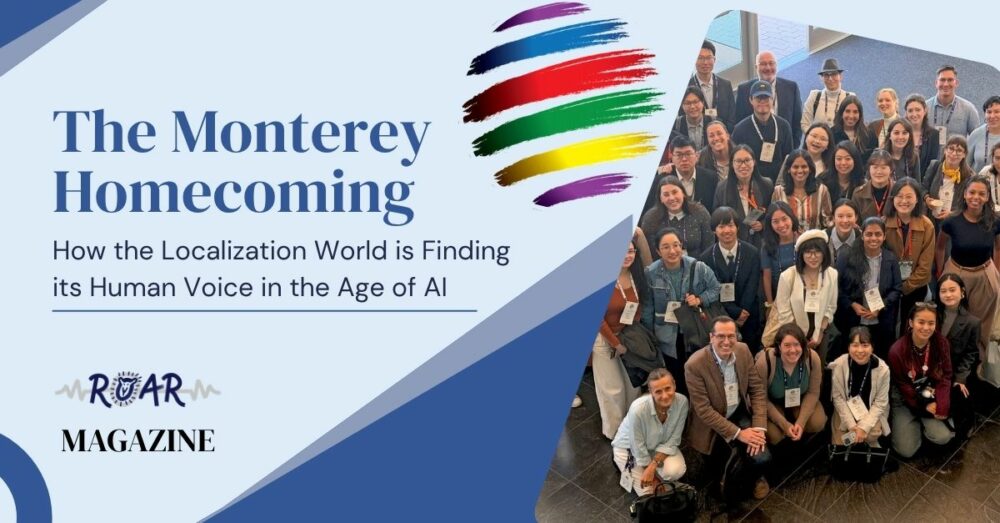
Written by: Peng Chen
I. The Cypress Scent of Reunion
With waves curling against the rocky shoreline and the Monterey cypress casting long, windswept silhouettes, Monterey once again welcomed the global localization community home. This October, LocWorld 54 didn’t just arrive on California’s central coast — it returned. After one year of global stops and industry evolution, the conference circled back to one of its most iconic venues, transforming the Monterey Conference Center into a buzzing crossroads of language, technology, and cultural thought leadership.
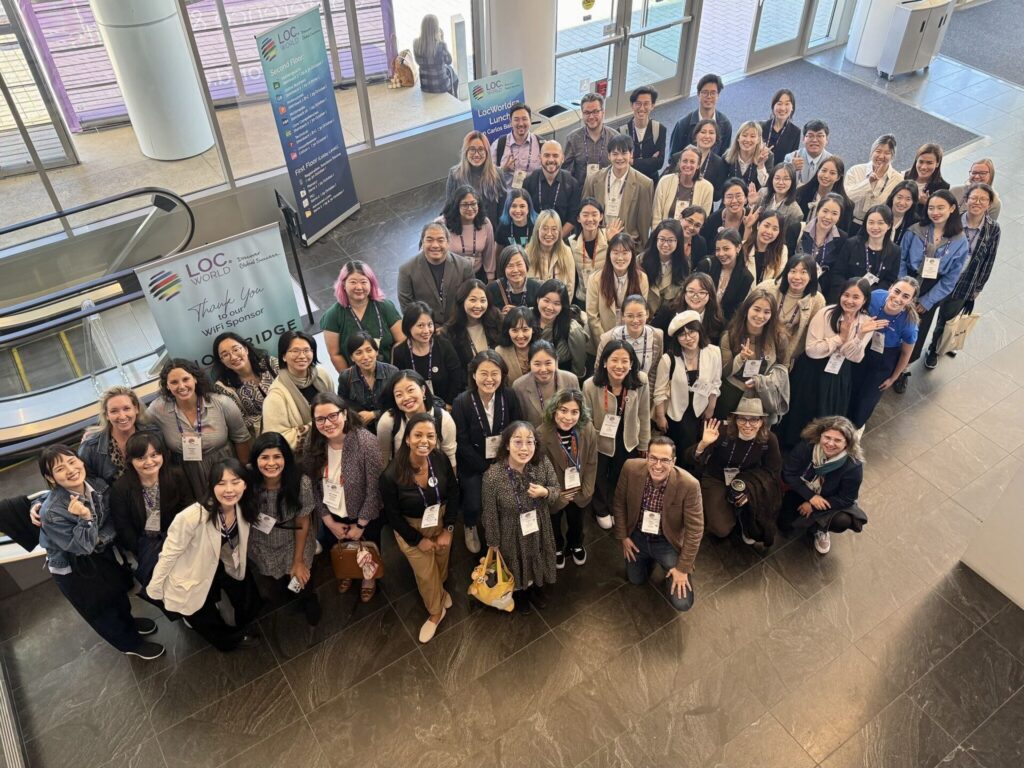
Returning to Monterey mattered. This coastal town has long been threaded into LocWorld’s DNA — a place where early conversations shaped the industry’s ethos and where many attendees first found their professional tribe. Coming back wasn’t nostalgia — it was a reminder of where the industry started and an invitation to reflect on how far it has come.
This year’s theme, “What’s Next?”, set the tone for an industry sprinting into the future. The agenda brimmed with debate and optimism around AI maturity, agentic AI workflows, and the growing trend of LLM-powered localization. The energy felt urgent — the industry is rewriting itself in real time.
Yet amid the demos, strategy sessions, and technical deep-dives, a quieter countercurrent emerged. It hummed in hallway conversations, echoed over coffee lines, and crystallized in Rika Nakazawa’s keynote, “From Code to Carbon — Decoding Nature, Recoding Humanity with ‘Organic Intelligence”. Her message: innovation is inevitable, but identity must be intentional. In a field defined by language, culture, and human nuance, the future demands we protect what makes us human even as machines accelerate what we do.
And that’s what made Monterey the perfect setting — not just scenic, but symbolic. Against the backdrop of the Pacific and the timeless pull of nature, LocWorld’s return felt like a grounding breath. A reminder that progress and roots are not opposites, but partners. When asking “What’s next?”, we must also ask “What’s worth carrying forward?”
LocWorld did not simply return to Monterey — it reconnected with its origins to better envision its future.
II. The House That MIIS Built: Anatomy of an Influential Network
Just a short walk from the Monterey Conference Center lies the Middlebury Institute of International Studies at Monterey (MIIS), a long-standing academic center for training global language and localization professionals. Its proximity to LocWorld 54 served as a symbolic link between education and industry, underscoring MIIS’s influence in shaping translators, interpreters, project managers, and localization specialists over many years. With so many MIIS students, alumni, and faculty participating, the conference felt less like a typical industry gathering and more like a vibrant professional homecoming.
Within the industry, the MIIS alumni network is a force of nature, affectionately and respectfully dubbed the “MIIS Mafia”. The term, coined with a sense of admiration, speaks to the pervasive influence and tight-knit community of its graduates. This is not merely a social club; it is a powerful professional ecosystem. Top employers like Google, Meta, and Amazon actively seek out MIIS graduates, viewing the institute as their “go-to source for finding localization management talent.” The speakers’ list for LocWorld 54 read like a directory of this network’s key figures, each embodying the legacy of their education.
Yanming Li, Senior Manager of Localization at Amazon, led a panel on “The Convergence of Language and Data Services — The Future of Multilingual Content”. Her career path — from linguist to quality director at an LSP to overseeing localization and upstream technical writing at a tech giant — exemplifies the multifaceted strategic leader the MIIS program cultivates.
Min Tan, a TI graduate at Google, joined the panel “The AI Maturity Journey: There’s No Autopilot (Yet)”, placing MIIS voices at the heart of the field’s most complex technological conversation.
Shirley Xu of Amazon Web Services (AWS) presented “LLM-infused Translation: Transforming Technical Documentation”, showcasing the deep technical fluency characteristic of MIIS talent.
The connection extended beyond current students. MIIS faculty—many of whom are also proud alumni, including Professor Max Troyer and Professor Eva Klaudinyova—played key roles as speakers, moderators, and industry bridges. Their presence highlighted the institute’s unique ecosystem, where graduates return as educators and continue shaping the next generation while keeping the curriculum aligned with industry evolution.
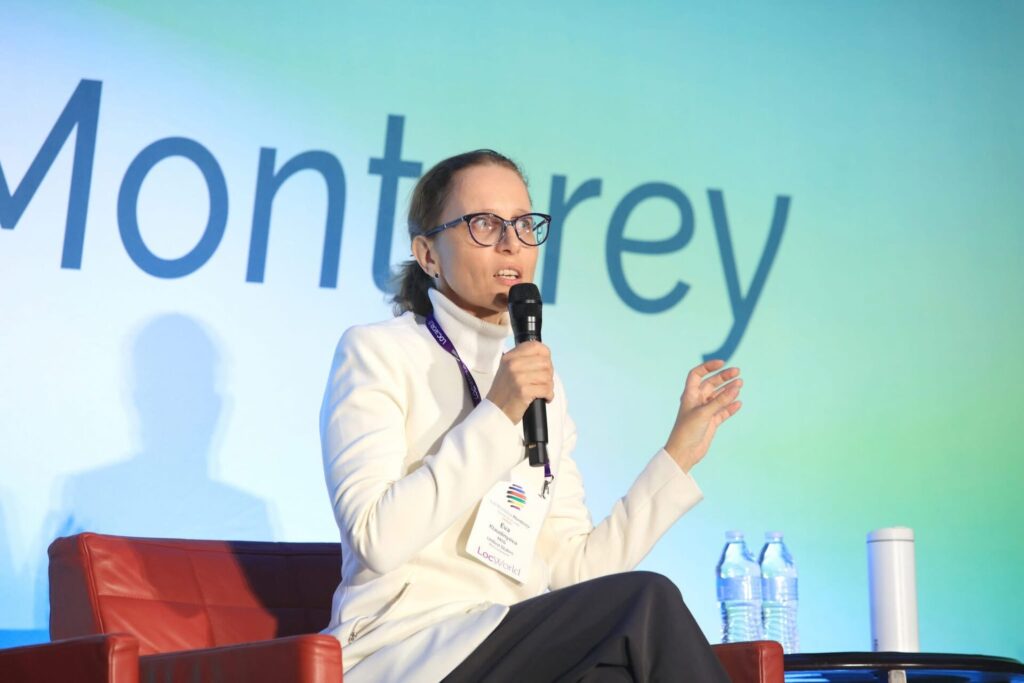
The true power of the “MIIS Mafia”, however, extends beyond simple networking. It functions as a cultural standard-bearer for the entire industry. The MIIS Translation and Localization Management (TLM) program, the first of its kind in the United States, instills a specific professional ethos—one that holistically integrates language, culture, business, and technology. By becoming the primary talent pipeline for the industry’s most influential companies, this educational philosophy has, over time, become the industry’s de facto gold standard. The network’s influence, therefore, is not just about helping graduates find jobs; it is about collectively shaping the industry’s DNA. In an era where the speed and scale of AI threaten to commoditize language services, this shared commitment to a nuanced, quality-centric, and culturally aware approach to localization acts as a powerful cultural bulwark, a constant reminder that at the heart of global communication lies not an algorithm, but a human being.
III. The Crucible of Innovation: A Glimpse into Tomorrow’s Toolbox
While much of the conference grappled with the present-day challenges of AI, a powerful current of forward-looking innovation was on full display, most notably at the 19th Process Innovation Challenge (PIC). A prestigious and long-running incorporated event at LocWorld, the PIC serves as a vital platform for the industry’s boldest innovators and their cutting-edge ideas. This year, however, marked a significant evolution with the introduction of the inaugural “PIC Sneaks,” a new showcase designed specifically for emerging talent to present visionary concepts. This initiative created a formal bridge between the industry’s established leaders and its next generation of thinkers.
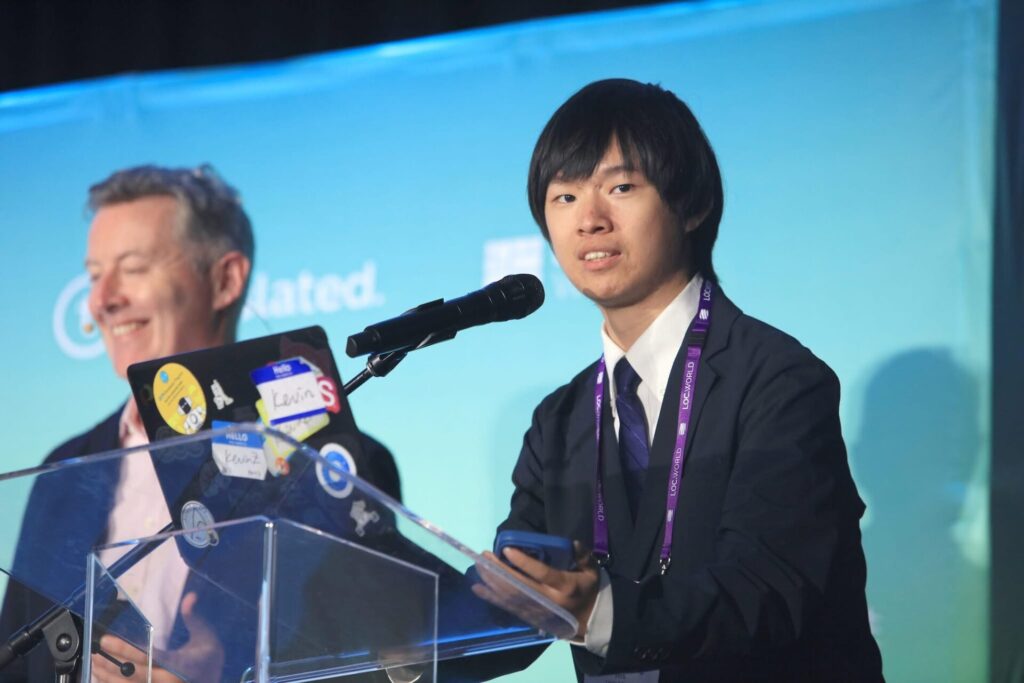
Fittingly, three MIIS students dominated the first-ever PIC Sneaks showcase. After a rigorous selection process, Three MIIS students — Kaiwen Zhao (T&TLM ’26), Jinxing Chen (TLM ’26), and Vieux Valcin (TLM ’27) — were selected to present forward-thinking solutions:
- An Open-Source S2T2S Workflow: A customizable Source-to-Target-to-Source framework for improving machine translation quality and consistency. (Kaiwen Zhao)
- The Preflight Localization Crew: An AI multi-agent workflow that identifies and flags critical cultural, legal, and market risks before a product is localized. (Jinxing Chen)
- LexiQ™: An AI-powered platform designed to perform linguistic quality assurance (LQA) for high-volume multilingual content. (Vieux Valcin)
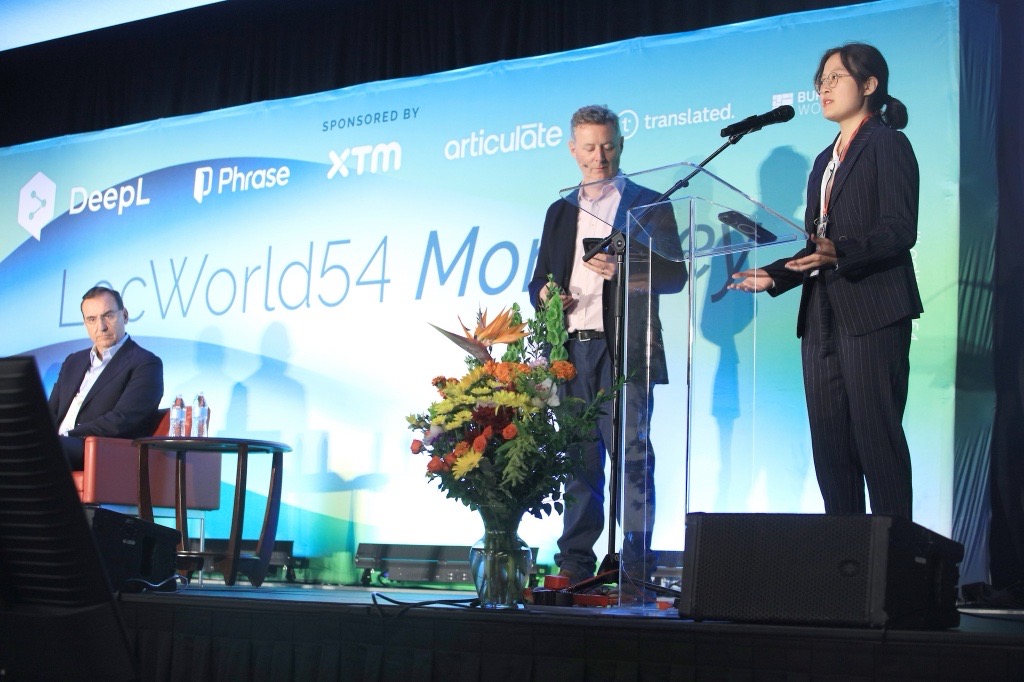
Jinxing Chen, one of the PIC Sneak speakers at LocWorld 54, presented Preflight Localization Crew, an AI-driven, multi-agent system designed to detect cultural, linguistic, and compliance risks before translation begins. Inspired by summer self-study of AI tools like CrewAI and LangGraph, she built a workflow that simulates a real localization team — including content reviewers, legal experts, and editors — to make localization proactive rather than reactive.
The project idea emerged after brainstorming with MIIS alumnus Binyuan about where automation and collaborative AI systems could most improve localization workflows. During development, she encountered challenges such as agents “cheating” by copying past outputs, generic results without tailored training, and the importance of precise prompt design.
Presenting at LocWorld was unexpected but transformative. Supported by mentors like Professor Max and Dave Ruane, she embraced the “head-fake” idea — rehearsals seem for pitch practice but truly help newcomers feel part of the PIC community. She believes AI represents a major technological shift and a rare moment where individuals can help shape the future amid uncertainty and rapid change.
These are some of the most technically unique innovations I’ve had the pleasure to witness. These projects are expected to continue development — perhaps evolving into industry-changing assets.
Professor Max Troyer
The creation of PIC Sneaks at this particular moment in the industry’s history is telling. In a period of intense disruption driven by AI, innovation can emerge from anywhere, not just from the R&D departments of large corporations. By formalizing a pipeline for student-led innovation, the established industry is making a strategic hedge. It provides a mechanism to identify, nurture, and integrate potentially disruptive ideas from agile, independent student teams before they can become external competitive threats. This initiative is a low-risk, high-reward strategy for the industry’s incumbents, giving them early access to cutting-edge concepts and the bright minds behind them. It is a savvy way to future-proof the existing ecosystem by absorbing and guiding the very forces that could one day upend it, ensuring that the next generation’s brilliance is channeled toward solving the industry’s own evolving challenges.
IV. The Connective Tissue: Where Business Forges Bonds
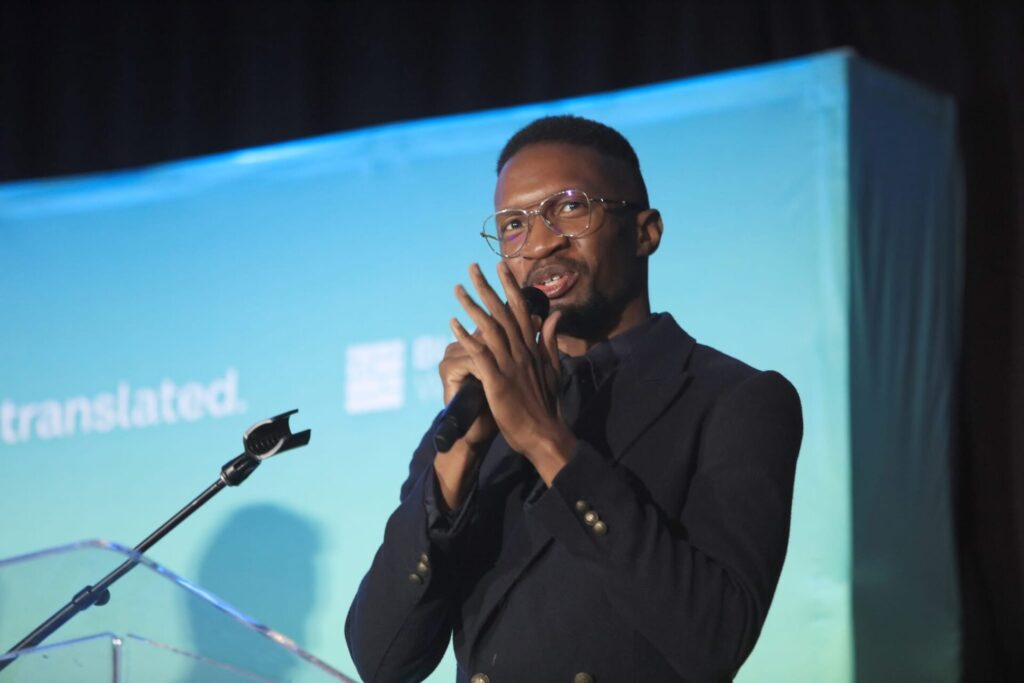
For all the talk of AI, data, and workflows, the recurring theme in testimonials about LocWorld is unequivocally human. As the conference’s own materials state, “When people talk about the value of LocWorld, they invariably mention networking”. This is not the transactional, business-card-swapping networking of other industries. It is a deeper form of community-building, fostered in a uniquely warm and collaborative environment. Attendees consistently describe LocWorld as more than a business event. It is a place to “network with friends, peers and new people from all over the world in an informal environment”.
The emphasis on community was also reflected in the sessions themselves—most notably in the Women in Localization Fireside Chat: Leveraging Global Experience for Career Growth and Competitive Edge. Hosted by the event manager for the Women in Localization – MIIS Chapter, Eva Zhuo, featuring Winnie Heh from Center for Advising & Career Services at MIIS, and highlighting the work of global marketing executive and author Nataly Kelly, the session went far beyond traditional career guidance to highlight the deep value of cross-cultural experience. As Advisory Board Member Maria Kania explained, the conversation encouraged professionals—especially women who have lived between cultures or worked across borders—to view their international backgrounds not as obstacles, but as powerful assets for leadership in today’s global organizations. Through Kelly’s insights, attendees explored how linguistic and cultural fluency drive business success, inspire innovation, and strengthen leadership. Much like the conference as a whole, this session underscored the importance of recognizing and elevating the human, intercultural skills that are increasingly vital in a globalized world.
In an industry facing the profound, potentially dehumanizing, and disruption of automation, this intense focus on high-touch, in-person connection is not just a pleasant feature; it is a strategic and psychological necessity. The more that day-to-day localization tasks become automated, the more valuable the human network becomes. Algorithms cannot replicate trust, serendipity, or the creative spark that ignites during a face-to-face conversation. The elaborate social architecture of LocWorld serves as a powerful antidote to automation. It is a conscious effort to strengthen the human bonds that are becoming the most critical differentiator in an increasingly machine-driven world. The business of global communication, as LocWorld 54 demonstrated, is ultimately built not on technology alone, but on the bedrock of human relationships.
VI. Conclusion: The Echo in the Roar
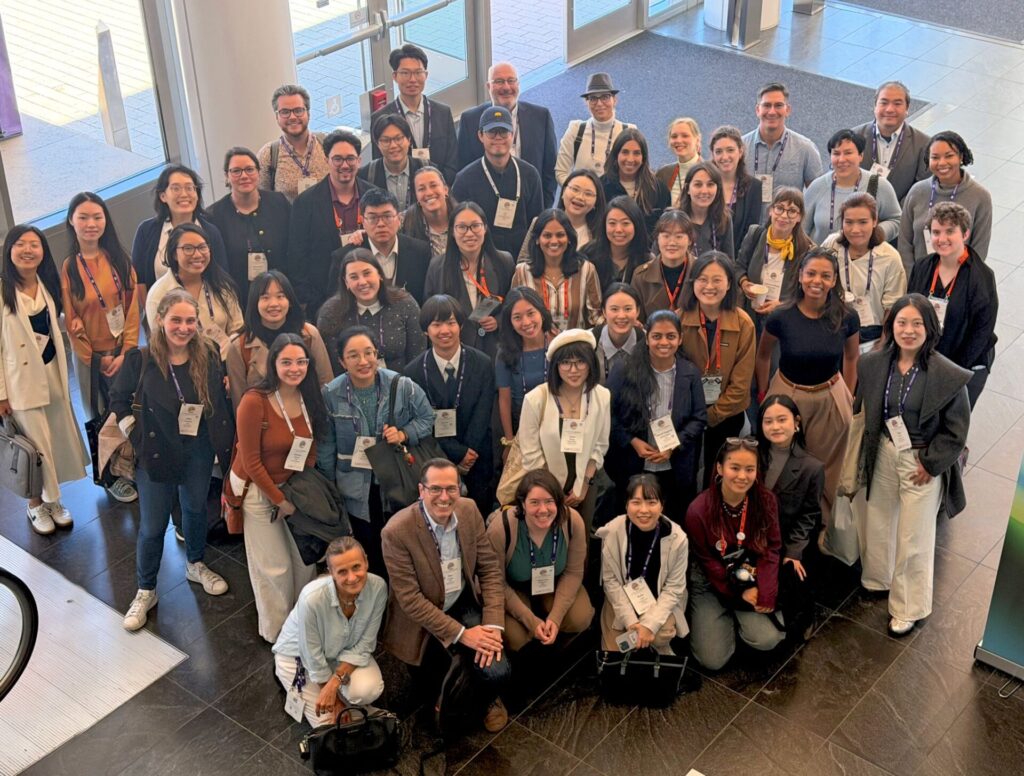
As LocWorld 54 drew to a close, the conversations that began in the conference halls spilled out into the Monterey evening, mixing with the scent of cypress and the sound of the Pacific. The event was a journey that came full circle, beginning and ending with a profound sense of place and community. The question posed by the conference theme, “What’s Next?”, found its answer not in a single technology or a definitive roadmap, but in a collective recommitment to balance.
The homecoming to Monterey was a return to the industry’s academic roots at MIIS, a powerful reminder of the humanistic foundation upon which the entire profession was built. It was a celebration of a “growing legacy that continues into 2025,” a living network of mentorship and shared values that stands as a bulwark against the forces of commoditization. The industry’s deep and mindful grappling with the AI paradox, anchored by the call for an “Organic Intelligence,” revealed a community that is choosing to be the master of its tools, not the other way around. By rigorously examining AI’s flaws, the localization world is rediscovering and reinforcing the irreplaceable value of human cultural and linguistic expertise.
The emergence of a new generation of innovators at the PIC Sneaks showcase provided a hopeful glimpse into a future where the industry’s foundational principles are carried forward with new energy and new tools. And through it all, the constant, vibrant hum of human connection—in hallways, at dinner tables, and on the dance floor—affirmed that the true strength of this global community lies in its people.
What’s next for localization is not merely the next LLM or the next automated workflow. The deeper challenge, as illuminated by the gathering in Monterey, is how to thoughtfully and ethically integrate these powerful technologies while nurturing the human insight, cultural wisdom, and personal relationships that give them meaning. The future of localization lies not in the roar of the machine, but in the human echo that gives it resonance.
