


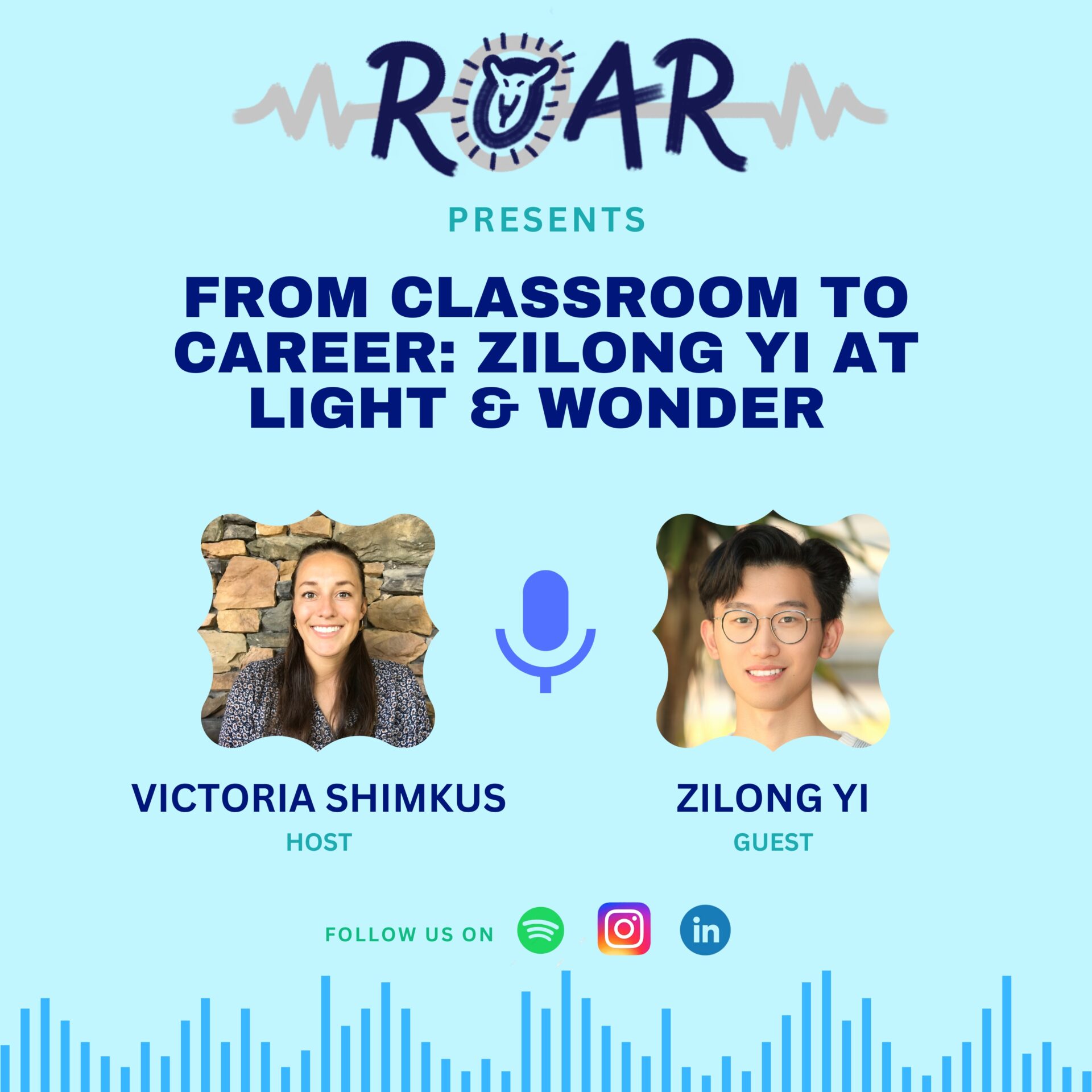
Join us as we talk to Zilong Yi, a Linguistics Compliance Intern at Light & Wonder, about his path from studying at the Middlebury Institute of International Studies (MIIS) to stepping into the game localization and compliance industry.
In this episode, Zilong shares how his MIIS coursework, professional experiences, and personal growth helped prepare him for his role, and what it’s like to apply linguistic skills in a global entertainment company.
Anchor link.
Transcript
Victoria: Welcome to another episode of The ROAR Podcast, a podcast produced by the Middlebury Institute’s Translation and Localization Management program bringing together global voices from the localization industry. I’m your host for this episode. Victoria Shimkus, today we will be talking with Zilong Yi, recent MIIS grad and linguistic compliance intern at Light & Wonder.
Victoria: Hi, Zilong, thanks for meeting with us today. How are you?
Zilong: Good. How are you?
Victoria: I’m doing well. Thank you. We’re gonna get started right away with our questions for you. Go ahead and tell us a little bit about yourself. What’s your elevator pitch?
Zilong: Okay, this might not be an elevator pitch, but a very brief self introduction about myself. So my name is Zilong Yi, and I recently graduated from MIIS. I have a background in translation, interpretation and localization management. I currently work at Light & Wonder, a gaming company based in Las Vegas as a product compliance intern. I specialize in games and multimedia localization. Kind of overlap there, and that’s exactly what I’m doing with my current job.
Victoria: Very cool. And what drew you to localization? Or how did you get your start in this industry?
Zilong: To be honest, I knew nothing about localization before coming to MIIS. Initially, I wanted to be an interpreter. I invested a lot of time and energy in practicing with partners and training all those stuff, only to find myself gradually losing momentum and becoming more interested in localization courses, because I love playing around with new technologies and working with people, working in a team, to be more precise. Being an interpreter is more of a like a lonely journey. You have to be super self-disciplined, self-motivated and super energetic every day to be really good at it, but I work better when I work in a team, so a localization related job might be a better fit for me. That’s my self discovery, and plus, I really like this intersection of languages, technologies and business. As I dive deeper, I’ve realized that this might be a better career choice for me. That’s how I got started.
Victoria: Yeah, I could see how the team appeal would be there. I’m I’m the same way. And congratulations on graduating last year.
Zilong: Thank you. Oh, actually, this year, this May.
Victoria: Oh, that’s right. Well, last school year, I guess.
Zilong: Time flies fast.
Victoria: Can you tell us more about your current position at Light & Wonder and maybe tell us some of your daily responsibilities and what your typical day looks like.
Zilong: Okay, sure, I was never a full-time employee until this job so Light & Wonder is my first career home. My major responsibility, if I’m going to put it in a very simpler way, is to make sure that the games can run smoothly in languages other than English on different platforms, for example, on slot machines or on those multi-terminal, multi-screen, electronical tables you’re never gonna miss if you walk into a casino. I work in a pretty small team, but very efficient in handling numerous localization requests days and months from our internal game development studios. That’s basically an overview of my job.
So speaking of some daily responsibilities. I usually start a day checking emails and clocking in just like most office jobs in this world. One of the things I really like about this job is the diversity of the tasks. So I can give you a few examples of what I do on a daily basis, but it really depends on, you know, what kind of projects I’m working on.
So one typical type of task is file prep. For this type of tasks, I usually need to download the game, put it down from the cloud, build the games on my PC, configure the environments for it to be able to run and give it a full playthrough. During this process, I need to trigger all the features, take notes or some screenshots of all translatable elements, organize them into one place before either I translate or I send it out to vendors to translate. If you are taking Max’s Game Localization class, one of my favorite classes at MIIS, this might sound familiar to you. What I’m doing right now is basically creating the so-called “picture list”, something you may find not fancy at all, but works perfect in our situation.
The second type of task I’m doing is linguistic review. I’m the only person in our team who understands Chinese. So I am the go-to person for any review of Chinese translation or any artwork that has been localized into Chinese. The latter usually involves communication between me and the studio artists.
The third type of task I’m usually do is translation and transcreation. We have vendor support for our Chinese translation, but I am also taking over some of the translation workload when there is not too much going on on my side. I’m also doing transcreation, as I just mentioned, for things like games titles, which my manager wants to, you know, do more internally instead of outsourcing to the vendors. Also, there are some other minor projects, like creating a term base for specific type of games, or some DTP, multilingual DTP work that I need to do through Photoshop. Yeah, basically, that’s all the things I do, and I really love the diversity there.
Victoria: Yeah, it sounds like it’s a good fit for you, too, especially with your translation and interpretation background.
Zilong: Yeah, exactly.
Victoria: And that localization piece. So I’m glad they’re keeping you busy and really working all the different parts of your skillset.
Zilong: Yes, I really like this, this kind of diversity.
Victoria: And you talked about using or doing a lot of different things and using probably some different tools, especially with Photoshop, DTP work. Are you able to share with us any of the maybe CAT tools, the TM systems or programming languages that you’re using on a daily basis?
Zilong: Oh yeah, sure. So for the CAT tool, we’re using MemoQ and for the programming languages, we never touch the code base of the games because those are taken care by the engineers and we don’t want to and can’t play around it by ourselves. I only use Windows command prompt and Windows PowerShell to download some internal tool packages and/or like change file names in bulk. That’s basically what I do with the programming languages. I will say this is a pretty code light position. Some other tools that we are using include, but not limited to game development engine: some ticketing systems, project management systems, Version Control platform, Adobe Creative Suite, as I’ve mentioned earlier, and some internal tools, yeah, that’s basically it.
Victoria: Okay, great. And I mean, we’ve learned some of these tools or some of these skills here at MIIS. Were there any tools that you particularly felt like were hard to learn that, maybe, you hadn’t already used here? Or how was that process for you?
Zilong: If you take, I think you must take Adam’s Translation Technology class, the translation, the CAT tool that we use most often is Trados, and for Max’s class, we use Phrase more. But in the job I’m doing right now, we are using MemoQ. Of course, if you are familiar with those CAT tools, the skills are transferable. You can easily transfer from one tool to another, but still at the very beginning, the interface is kind of different, and we have our own way of uploading and downloading and managing the TM and also the term base. So at the beginning, it’s kind of take some time to transition to a new tool.
Victoria: Yeah, that makes sense. Were there, like, processes in place to help you learn those things, or trainings provided?
Zilong: Yes, we had our own training notes, like close to 100 pages that I needed to go through in the first few weeks. Of course, I did not read all of them, but I have them pretty handy. And whenever I need something, I can refer it pretty easily. And also, I think some company will also, just like our company, have some Wiki pages specific to your department, localization department. There are a lot of useful resources out there as well.
Victoria: Okay, cool. And what would you consider to be prerequisites for someone working in this position?
Zilong: For my position, specifically, I would say linguistic skills are very necessary, the ability to do translation, transcreation, review, post editing. Yeah, you got to a half the translation level proficiency in a second language to be able to take this job. And second, I will say, is tech savviness. Just as I’ve mentioned earlier, you are gonna use a lot of new software and platforms, and you have to be pretty tech savvy, or at least a quick learner of technologies to be able to fulfill those responsibilities.
Victoria: That definitely makes sense, and I feel like they really try and train us in that here. So that’s that’s good as well.
Zilong: Yes.
Victoria: You already talked about some of the things that you enjoy about your job. Is there something in particular that brings you a higher sense of accomplishment in what you do or what brings you, maybe, the most joy out of your job?
Zilong: I would say it’s definitely the supportive team that I like most about my job. Everyone in our team is super friendly, easygoing, caring and responsive. That’s the most important part, right? And I think when I see a game running in languages other than English, mostly Chinese, and no issues are found, no more requests for changes, and no resubmission is needed, I think that moment is the happiest for me.
Victoria: That’s awesome. Yeah, I honestly didn’t even realize that casino games were in different languages, and that’s a whole different issue, my English privilege and all that. But you get to play them and test them, right?
Zilong: Yes, just like I’ve mentioned one of my tasks, type of tasks is file prep. I need to download the game and build the game on my personal laptop and give it a full playthrough and identify all those translatable elements. When I say translatable elements, I mean because there are different types of things that should be translated or localized, including some, you know, plain texts, PNG files, and also some special format animation files that we need to localize.
Victoria: And you play the game at the very end. Also, though, when it’s complete, yeah.
Zilong: Exactly, exactly. That’s what we call build review. That’s after everything is implemented. We need to run again and again to make sure that everything looks good, no text truncation or, you know, overflow issues.
Victoria: Very nice. And what would you consider to be the greatest challenges in your position?
Zilong: Greatest challenges? Okay, great question. I cannot go into details of the parties involved, but one of the biggest challenges that we face is handling the requests for changes that could happen to the either the source content or the translation at any step of our process. Sometimes these requests come early, but oftentimes they come pretty late in the process, which can be difficult to accommodate, and which also increase the likelihood of introducing new errors. So for our department, we always try our best to accommodate some, you know, critical changes, while pushing back unnecessary ones or reserving those for like a future revision. But you know, we have different standards of what is critical, what is necessary versus what is not that necessary. So this can be a very challenging part of my job.
Victoria: Yeah, I think that they warn us a lot about that as well in our classes. So sounds like that’s really, really happening in the workforce.
Zilong: Yeah, exactly.
Victoria: And how important is your localization department at your company? Is the localization happening from the beginning? Is localization in those conversations, or is localization an afterthought like, how is localization, I guess, treated in your company?
Zilong: I think we are still on our way to upstream localization. Localization is still happening at the pretty later phase of the whole, you know, development process, which is something we try our best to improve in the future, and how important it is. I would say in our case, we are under product, and we operate in a centralized model, which means that we take care of all the localization requests coming from our internal game development studios. I will say we are like small gear in a much larger machine, but the machine is not able to run at full speed without us. We’re the key to unlock the new markets, and we’re definitely bringing more revenue to the company.
Victoria: That’s a great visualization. Thank you. And then, of course, AI is all over the place. We’re curious to know, what is the role of AI in your workplace, and maybe what if you’re using it? What are limitations of using AI?
Zilong: Okay, before taking this question, I want to give you a little bit more background information of what we are doing at Light & Wonder. So games on a gaming machine are so different from other games, they are generally not that text heavy. They’re very few texts on each one of those games, and the user experiences usually rely on some fancy visuals, symbols, animations and sounds, instead of super long narrative texts. So as localizers at Light & Wonder, we focus more on clarity, consistency and a compliance of those elements. So we want to make sure that those comply regulations provision, all these factors make us kind of hesitant about having AI taking over some of the work. We’re definitely exploring solutions to automate some processes, and we actually have a major change in terms of process recently, and we are also working to, you know, work more seamlessly across different platforms, but I do not see that happen in the short term.
Victoria: That makes sense.
Zilong: I hope this answers your question.
Victoria: No, it definitely does. And thanks for giving us more of that background, because it helps paint the whole picture. This is kind of a side note question. Especially the casino games: are they located in different places of the world? Are there games in China, and then people are playing them? So the currency and all that stuff is also being localized?
Zilong: Yeah, exactly the region-specific. So in China, in Mainland China, gambling games are forbidden. You can only do it in Macau. And for Macau, this specific locale, we need to have all the things localized into simplified Chinese first and then all of the translation needs to meet this, the laws and the regulatory body their requirements there.
Victoria: Makes sense and sounds very complicated. Most of our audience is probably students here at MIIS and I think it would be really helpful for us to hear about how moving from being a student to being a working professional has been for you, and then maybe you can give us any advice as we begin or continue our job search?
Zilong: Yeah, sure. For me, I think the transition from a full-time student to a full-time employee is relatively seamless to me, and relatively, I would say, what’s the word? Natural? Because I think there are so many things that I learned from the MIIS TLM program that are immediately applicable in my current role, and I want to shout out to the TLM curriculum and the professors as well. The advice I have for students who are in the search of jobs, yeah, this might sound a little bit like a cliche, but I think it’s definitely the truth.
The first piece of advice I would give is don’t give up just to keep submitting the applications. I know how struggling it is to find internship or a job. I’ve been there, especially at a time of policy uncertainties for international students, I would say, do not worry about it too much, just to focus on what you should do right now, and things will definitely work out eventually. Don’t give up and have a little bit more patience.
The second advice I would give is do not limit your choices. I think we should all be open to opportunities that might not perfectly match the expectations, but can still help us grow. I have a friends, actually, several friends who ended up taking jobs like bilingual project manager or bilingual sales assistant, which does not match our program perfectly, but I think these are definitely a great starting point. So the most important thing, I think, is to not limit the choices to the keywords localization only. And of course, network, of course, can emphasize more. It definitely opens some, you know, unexpected opportunities which are not posted on LinkedIn.
Victoria: Thank you. That’s, that’s great advice, and especially with LocWorld coming up that.
Zilong: Oh yes, yeah, big and huge networking opportunities. One of the things I usually do before networking events, it I would, you know, prepare a lot of questions and do a little bit research on the people I probably will going to talk with, learn about their expertise. And, you know, you know, come up with the questions accordingly. I think that’s probably will lessen the awkwardness.
Victoria: Definitely. Let me ask this final question. What is something you learned at MIIS that you find the most useful in your current role?
Zilong: Just like I’ve talked about earlier, besides the art skills that are immediately applicable, I would say the dual perspective of translation and project management is super useful. And give you a few examples I would often request for more context information, be it screenshots or written explanation for some of the streams that need to be translated into other languages, either for myself or for my vendor, which saves a lot of time. That would have been wasted on sending emails back and forth just to confirm things, and also when artists are going to recreate some of the complicated art in the target language based on my or my vendors translation, I know what kind of supplement information that is necessary for them to, you know, work out the translated or localized version, because the artists do not speak the target language, you have to have some, you know, extra information for them to recreate the work. And I think the ability to anticipate stakeholders needs, which comes from this dual perspective, really helps, helps me a lot in the current job.
Victoria: That’s awesome. Well, thank you so much for sitting down with us for this interview. Yeah, of course, it’s been great getting to know you, because I know we never really connected too much at school, but sounds like you’re doing a good job and learning a lot, and I wish you all the success in the world.
Zilong: Yeah. Thank you so much. Thanks for having me, and I wish you both wonderful rest of the semester too.
Victoria: Thank you so much for listening to today’s ROAR podcast with guest Zilong Yi, stay tuned and see you next time.
